Chain Abstraction
One key. Every chain. Control assets across 31 blockchains from a single wallet.
One Key · 31 Chains

Home wallet
Ethereum
 Bitcoin
 Solana
 Zcash
ZcashNEAR Intents
Chain Abstraction
One key. Every chain. Control assets across 31 blockchains from a single wallet.
31
chains
100+
assets
~30s
settlement
1 day
to integrate
How It Works
User connects their existing wallet
No new account required. The user connects their current wallet — Ethereum, Solana, Bitcoin, Zcash, or any supported chain. This becomes their master signing key.
Examples
NEAR Intents
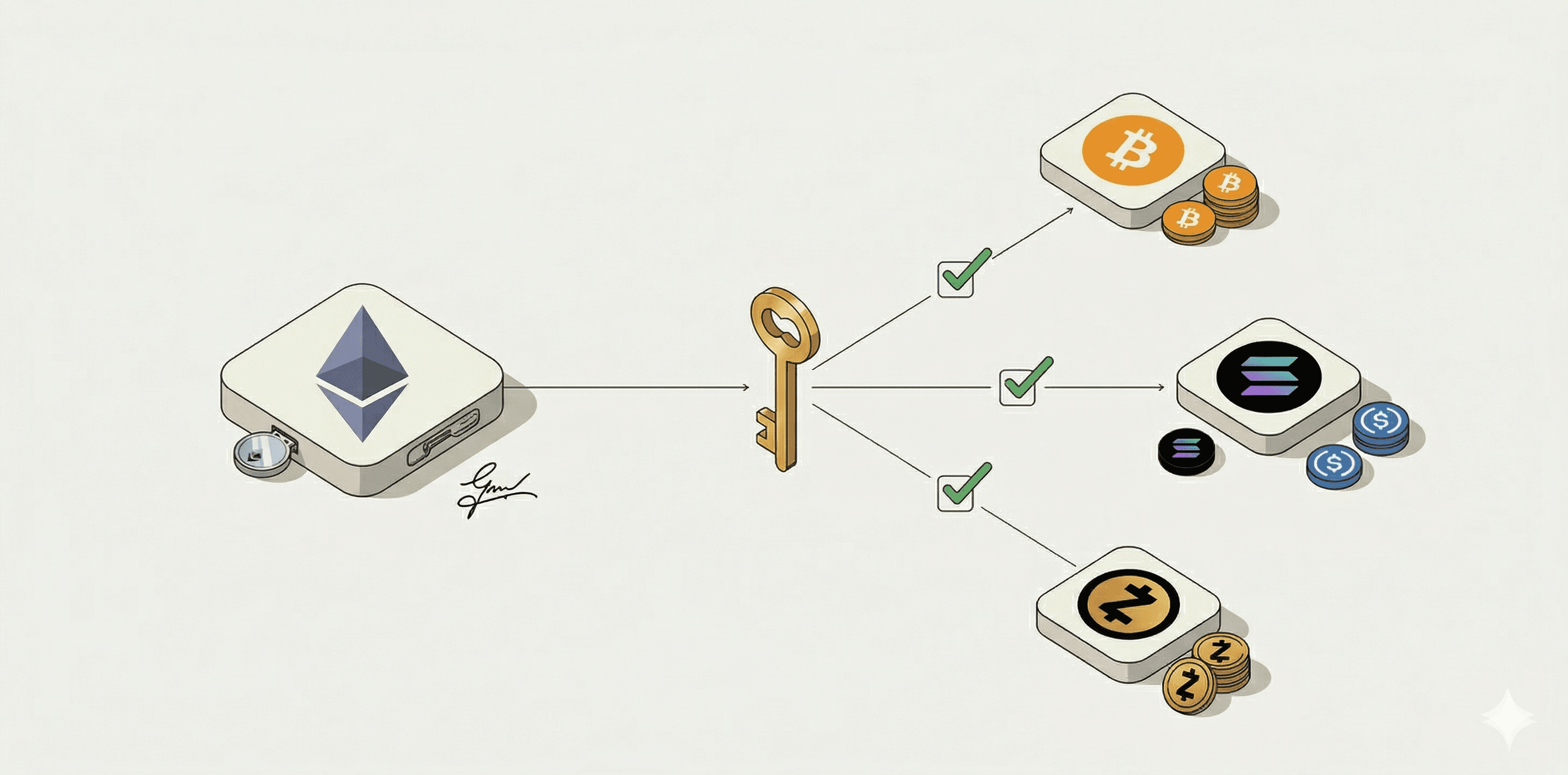
One Ethereum signature controls assets on Bitcoin, Solana, Zcash, and more — powered by NEAR Chain Signatures
User Stories
Using An Ethereum wallet with chain abstraction
- 1Opens their ETH wallet — sees a 'Multi-Chain Assets' section
- 2NEAR's MPC network derives a Bitcoin address and a Solana address from their ETH key
- 3User sends BTC and SOL to their derived addresses
- 4Assets sit natively on Bitcoin and Solana, controlled by the ETH signature
- 5User sends, swaps, or withdraws — all signed from their existing Ethereum wallet
Without NEAR Intents
Install a Bitcoin wallet, install a Solana wallet, manage two additional seed phrases, manually coordinate across three apps. Three keys, three UX surfaces, three failure points.
Using ZODL
- 1Opens ZODL → navigates to cross-chain holdings
- 2NEAR's MPC network derives a Base address from his Zcash key
- 3Bob receives USDC on Base at his derived address
- 4USDC sits natively on Base, fully controlled by his ZODL wallet
- 5Bob can move it, spend it, or swap it — all from ZODL, all with one signature
Without NEAR Intents
Install MetaMask or Coinbase Wallet, create a new account, bridge assets manually, manage two separate key sets. Defeats the purpose of a focused single-chain wallet.
Using A multi-chain wallet
- 1Integrates NEAR Intents Chain Signatures SDK — one integration
- 2Users' existing master key automatically derives addresses on all 31 supported chains
- 3Users see a unified portfolio: Bitcoin, Ethereum, Solana, Cosmos, and more in one view
- 4All transactions signed with one key — no chain-switching UX or re-authentication
Without NEAR Intents
Implement ECDSA derivation for EVM chains, separate Ed25519 handling for Solana/Cosmos, Schnorr for Zcash, Taproot for Bitcoin — different curves, different standards, months of engineering per chain. Then maintain them all separately.
Using A DeFi protocol on Base or Arbitrum
- 1Protocol integrates NEAR Intents chain abstraction
- 2Users connect their BTC or ZEC wallet — MPC derives a controlled address
- 3User signals intent to deposit; MPC executes the move on Bitcoin/Zcash natively
- 4Assets appear in protocol — no wrapped tokens, no bridge transaction for users
Without NEAR Intents
Users manually bridge BTC → wBTC, losing native properties and adding trust assumptions. Requires users to understand bridge mechanics and manage bridge approvals.
Case Studies

Ready to add chain abstraction to your product?
Integrate cross-chain capabilities in as little as 1 day with the NEAR Intents widget, or 1 week via API.
